Hopp til innhold

Norsk nettbutikk | Rask levering | Frakt i hele Norge

Produsent

Old Blood Noise Bathing ...

4.690,-

Bathing Liminal Delay Exploiting an algorithmic similarity, Old Blood Noise Endeavors unveils Bathing, a feature-rich pedal that features what the brand have named “Liminal Delay”. This effect is not just a classic delay, a modulation or even a multi-tap reverb. It is all of those things at once. Taking inspiration from OBNE’s “phase repetition” in their Dweller pedal, Bathing takes this difficult-to-describe effect and highlights all its magical features through a wide control set, low noise floor and an expansive stereo field. With features like MIDI, expression control and presets, to store and recall your favourite Liminal Delay sounds, Bathing allows you embark on a sonic adventure, only to then find it to be your new home. Main Features: • "Liminal" Delay pedal • Stereo Input and Output, with the option for Mono or Mono-in-Stereo-out routing • Dedicated knobs to control Central Delay Time, Tone and Feedback • Additional controls for the number of Stages the delay passes through, including the Rate, Depth and Shape of the modulating character of those stages • Independent controls for dry and wet volume • Separate subtle Stereo Chorus control • Analog Dry-Through • Expression and MIDI control over all parameters • MIDI clock I/O for external temp syncing • Onboard Presets, plus control via MIDI • Selectable Buffered Trails or True Bypass modes • Top-mounted Jacks and Soft-Touch Switching • Hand-made in Oklahoma, USA • Available in 3 Colourways - Algae (standard), Orchid and Ink • Powered by (opt.) 9 V DC PSU (centre -, 2.1 mm, ~ 350 mA current draw, not included) The core sound of Bathing is determined by a central delay line, divided into many stages called “all-pass filters”. The Time control sets the central delay time. Use the Stages control to set the number of all-pass stages that the delay runs through, from anything between two to twelve stages. At shorter time settings, this increases the intensity of the phase/flange effect. At medium or longer time settings, more repeats are created both before and after the central delay time. Feedback sets the feedback of the delay, taking the output and feeding it back into the input. This can create longer trails and increased resonance. The Filter applies a combination of low pass and high pass filtering to the output of the delay, as well as the delay feedback loop, with the darkest sound to the left and the brightest sound to the right. The LFO affects the character of the delay repeats. When Time is very short, it acts like a modulation effect (think phaser or flanger). When Time is set longer, it moves anywhere from a single repeat at the central delay time out to a scattering of many diffused repeats around that time. In Mono-in, Stereo-out or full Stereo modes, the LFO is offset on the left and right to create a variety of stereo effects.
Old Blood Noise Beam Splitter ...

3.121,-

Old Blood Noise Endeavors Beam Splitter Automatic Triple Tracker Distortion The Beam Splitter is a single pedal meant to create a massive sound. It is three different takes on overdrive, voiced to work together perfectly. Two of them can be delayed in time, and all three can be run in parallel or split out to three separate sources. Beam Splitter takes a mono input and makes it wildly bigger than before. Things stretch in time and compress in dynamics, and a rich harmonic wash is achieved without sacrificing clarity. • Triple tracking overdrive/distortion pedal • 3 different parallel drive/distortion sections with individual gain and volume controls and adjustable delay and individual outputs o Purple – hard clipping distortion – the pedal’s core gain sound o Green – soft or hard clipping overdrive with the light and bright sound o Blue - transistor Overdrive - most neutral and reactive with a medium gain range • Offers triple-tracked drive tones with impressions of flanging, chorusing or broken vibrato, depending on the settings • Individually adjustable delay time on Green and Blue distortion sections • Feedback controls for Green and Blue distortion sections to add intense filtering or trailing delays depending on Time setting • Deviate Control for adjusting randomness of delay time variation in Blue and Green drive sections – for a more realistic sense of doubled players • EXP input – for controlling Deviate knob remotely • Relay bypass switching • Made in the USA • Powered by 9V DC PSU o (centre -, 2.1 mm, 150 mA current draw)
Old Blood Noise BL-52 Phase ...

2.508,-

Old Blood Noise Endeavors BL-52 Phase Repeater Variable Clock Phase Repeater Further pushing the boundary of clock-defined pedals, the latest entry in Old Blood Noise Endeavors’ BL series is a Phase Repeater, in the process making a genre entirely of its own. Phase repetition takes the modulation of a phaser and applies it to the realm of time, creating a completely unique sound and more like delay or reverb than its namesake phaser. First used in the OBNE Dweller pedal, the BL-52 Phase Repeater represents a new spin on the sound, with simple controls including a Clock slider that enlightens the timing of everything in the pedal. Main Features: • Phase Repeater Effects Pedal • Creates sounds that are between phaser, delay and reverb tones, by applying the modulation of a phaser to time • Simple, yet interactive control layout - gives immediate tactile experience that encourages experimentation • Clock slider - changes the delay time, LFO speed and overall fidelity of the effect, from faster repeats to time-stretched lo-fi • Feedback knob - enhances the intensity of the phase repetition by further lengthening the trails • Wet/Dry Mix control • Soft-touch bypass switching • Pedalboard friendly size • Made in the USA • Powered by 9V DC PSU (centre -, 2,1 mm, ~110 mA current draw)
Old Blood Noise BL-82 Chorus ...

2.508,-

Old Blood Noise Endeavors BL-82 Chorus Variable Clock Effector Seeking to unapologetically tear apart the common definition of a chorus pedal, Old Blood Noise Endeavors have created the BL-82 Chorus. An ode to delay time, this is a device with a variable clock control to shift between recognizable shimmering chorus and chaotic modulated delays. Two delay lines, modulated by opposite synchronized LFOs, are combined in parallel and the timing of the delay lines, as well as the speed and depth of the LFOs, are all determined by one tactile slider. This allows you to instantly open up the modulated floodgates on the fly and go from well-known waves, to deeply unknown oceans of sound. Main Features: Chorus Effects pedal Creates Chorus and Flanger like sounds by use of two modulated delay lines with opposite synchronised LFOs Simple, yet interactive control layout – for immediate tactile experience and to encourage experimenting Clock slider – changes the effect from fast and high-fidelity to slow and degraded  Feedback knob – enhances the intensity of the chorus/increase the amount of delay repeats  Wet/Dry mix control Soft-touch bypass switching Pedalboard friendly size Made in the USA Powered by 9V DC PSU         (centre -, 2,1 mm, ~110 mA current draw)
Old Blood Noise Black ...

4.307,-

Black Fountain Stereo Characterful Delay Pedal Building on the inimitable Black Fountain, a pedal that put OBNE on the map and for many a favourite always-on device, Black Fountain Stereo is much more than just turning things from mono into stereo. It truly expands Old Blood Noise Endeavors' highly regarded ‘oil-can delay’ pedal right into a multi-tool. With a wider control set that’s complete with added sonic options, a lower noise floor, dual delay lines that play together in a multitude of ways, presets, MIDI and expression control over everything, Black Fountain Stereo combines a sonic powerhouse of creative delay tones and into a pedalboard friendly package. Main Features: Characterful ‘oil-can delay’ pedal Stereo input and output, with the option for Mono or Mono-in-Stereo-out routing Dedicated knobs to control Rate and Depth of modulation plus Tone and Grit of delay voicing Time and Subdivision controls for each delay line Additional controls for feedback, Wet/Dry Volume and Stereo Space Analog dry through Expression and MIDI control over all parameters MIDI clock I/O for external temp syncing Onboard Presets, plus control via MIDI Selectable Buffered Trails or True Bypass modes Top-mounted jacks and Soft-Touch Switching Hand-made in Oklahoma, USA Available in 3 Colourways - Cream (standard), Terracotta and Slate Powered by (opt.) 9 V DC PSU                (centre -, 2.1mm, ~ 350 mA current draw, not included) Black Fountain Stereo emulates the sound of a spinning oil-can delay. This is a warm, modulated and a little gritty type of tone that’s perfect for chorusing, doubling, slap back and long rhythmic delays alike. You choose the amount and rate of modulation, the tone and grit of the core voice, the two delay times and their feedback. Plus, to top it off the mono/stereo voicing of it all can be set exactly as you like and everything can be saved into presets, for easy recall. The Rate and Depth controls set the amount of modulation and speed, Tone shapes the warmth of the repeats, while Grit sets the amount of drive in the repeats. To help maintain the clarity of your tone or for more special effects, you can set the mix of volume of either the Dry and/or Wet levels. Space defines the mono delay mode or stereo width and adds diffusion past the noon position. Separate controls are available for setting the Left and Right Delay Time as well as being able to choose between six subdivisions for each side when holding the Tap footswitch. That little Tap switch (surprise) helps you set the delay repeats in time with your tempo, while holding it down will give for infinite feedback. Optionally, it can also be used as a preset switcher.
Old Blood Noise Dark Star ...

4.307,-

Old Blood Noise Endeavors Dark Star Stereo  Flagship Reverb Pedal The continued pull, the drift unabated, the controlled wash of gravity and the chaotic meander of its combined uncertainties. In fact, the original and highly loved Dark Star is a pedal that historically was OBNE’s most popular reverb. People bonded with its warmth and aliasing, its long trails and the way it encouraged you to turn the mix fully up.  Now, it’s in with the new. Dark Star Stereo expands on the promise of ambient reverb and is a pitch shifting, bit crushing, filtered reverb pedal with just about every feature you could ask for. One massive stereo voice, with a wide suite of controls that likes to go anywhere in your signal chain - all that’s left is for you to decide just how dark you must go. Main Features: • The next evolution of OBNE’s Dark Star - ambient reverb pedal • Stereo input and output, with the option for Mono or Mono-in-Stereo-out routing • Dedicated knobs to control Filtering, Pitch-Shifting, Bit-Crushing/Saturation • Additional “Multiply” feedback loop, Mix, Volume and Stereo-Spread functions • Individual controls and coloured LEDs  • Expression and MIDI control over all parameters • Onboard Presets, plus control via MIDI • Selectable Buffered Trails or True Bypass modes • Top-mounted jacks and Soft-Touch Switching • Hand-made in Oklahoma, USA • Powered by (opt.) 9 V DC PSU                 (centre -, 2.1mm, ~ 350 mA current draw, not included) Reviving the magic of the long-trail lo-fi reverb algorithm that made Dark Star a breakout hit years ago, Old Blood Noise Endeavors announces a new Dark Star for a new era, with a drastically expanded feature set and improved signal quality that is sure to draw in old fans and new.  New features like Stereo Input and Output, on-board Presets, Trails, Expression control over all parameters and MIDI control, of both Parameters and Presets, all help to give more versatility to this device than ever before. Beyond that, the new Dark Star does away with the three-mode toggle, instead creating a single mode combining all the Pitch-Shifting, Bit-Crushing, delayed goodness of the original. Access your favourite sounds as well as new combinations, with new shapers like Filter, Multiply, Volume and Stereo-Spread. With Dual Pitch-Shifting capabilities for its independent Left and Right channels, when running in Stereo, the Dark Star can create lush or discordant textures, ranging from subtle detunes to dramatic double octave shifts. The pedal also includes a versatile Filter control that lets you shape the reverb signal with a high or low pass filter, for customised clarity. The built-in Crush distortion adds unique textures, with settings that move from subtle soft clipping to intense lo-fi grit. Additional controls for Lag and Decay let you set the Reverb pre-delay and decay time, while Multiply and Spread bring unique feedback and stereo width control, enhancing depth and intensity. The Dark Star’s Aux footswitch can be customised for momentary or latching effects, like infinite sustain, low-pass filtering, or instant octave pitch shifts, providing flexible creative control at your feet. Save and switch between three unique on-board presets, with clear LED indicators and use the Expression Jack for hands-free dynamic control over any parameter.  Adding to the pedal’s extensive flexibility, the Dark Star is fully MIDI compatible with presets being selectable via Program Change messages as well as all parameters being accessible and controllable via CC. With both Mono and Stereo routing options, plus selectable True-Bypass or Trails modes, the Dark Star offers a comprehensive blend of both intuitive and advanced features for musicians that are looking to sculpt immersive soundscapes.
Old Blood Noise Excess V2 ...

3.009,-

Old Blood Noise Endeavors Excess V2 Distorting Modulator A Marriage of Distortion and Delay-Based Effects Way back in 2017, Old Blood Noise Endeavors released their first venture into Distortion aligned with Delay-based effects. Aptly named Excess, we all thought it was fantastically excessive enough back then, but along comes 2022 and Old Blood Noise are adding more switches. Despite this, the controls are actually dead simple, but the sonic potential is immense! Expanding on the original model, Old Blood Noise Endeavors continues their journey to revive and expand sought-out sounds of the 80s. With delay, chorus and harmonized fifths available, along with distortion in series or parallel configurations, Excess V2 unveils more unique tones and even more control, yet all in a smaller more pedalboard friendly package. Main Features: • Distortion and Modulation pedal • Three modes of modulation (Delay, Chorus and Fifth) each with Time, Depth, and Volume controls • Distortion section with control over Gain, Tone and Volume to access light overdrive through fuzzy distortion • Order switching to run Distortion into Modulation, Modulation into Distortion, or separate parallel paths • Soft touch switching and true relay bypass for each section • Expression jack to externally control Rate and Depth • Internal trimpot to set wet-dry mix of Modulation section • Made in the USA • Powered by 9V DC PSU (centre -, 2.1mm, ~125 mA current draw) Simply put, Excess V2 is two effects in one: a distortion and a modulation. The modulation takes the form of chorus, delay or pitch shifted delay and the way you route and engage them makes all the difference. Each mode has its own footswitch to engage or disengage the sound. We’re thinking about circuits from the 80s, 90s, today and a little bit earlier, all helping to create tones you’ve never thought of before! Excess V2 features three modes of modulation. Fifth is a harmonized delay and harmonizes the delay repeat up to a perfect fifth. When depth is turned up (adding delay repeats), those repeats continue to harmonize upward, creating rising fifths and octaves from your original note. Chorus offers a classic chorus, modulating the delay line to create swirling sounds. Delay is a short delay (up to 125ms) focused on comb filter, doubling, and slapback sounds. This section features three knobs, Mod Vol which controls the volume of the modulation, from zero to loud, Rate controls the rate or time of modulation (either the speed of the chorus LFO or the delay time of the delay) and Depth adjusts the depth or feedback of modulation (either the width of the chorus LFO or the number of repeats of the delay). The Distortion section also has three knobs. While Dist Vol controls the volume of the distortion, from zero to loud, Tone controls the high end of the distortion, from dark to bright. Gain adjusts the gain of the distortion, from bright and almost clean to heavily distorted. There are three ways of routing the effects in the Excess V2: • Mod 1st runs modulation into distortion, creating harmonically rich and sometimes almost out of control textures. Because the effects are in series, if either volume control is all the way down, you will get no signal.   • Parallel runs modulation and distortion side by side, which allows for clean modulated signal alongside distorted signal.  This mode has a natural volume boost due to the signals being added together. Blend to taste with the volume knobs and find some unfamiliar wet-dry textures.   • Dist 1st runs distortion into modulation, which is a classic way of routing these two effects, allowing for crisp repeats and modulations of your distorted sound. Because the effects are in series, if either volume control is all the way down, you will get no signal. Internally the Excess V2 has a hidden trimpot located above the expression jack that sets the mix of the modulation section. By default, it is set for a 50-50 mix of dry and wet, allowing for classic chorus and unity volume delay repeats. To increase the mix, turn to the right: this can go 100% wet (affected signal) for true pitch vibrato and strange delay textures. To decrease the mix for more subtle modulation, turn to the left: this can go 100% dry (unaffected) leaving only clean signal on the modulation side. For even more creativity, the Expression jack can be used to externally control the Rate and Depth knobs. To use it, plug an expression device in using a TRS cable (we recommend the OBNE Expression Slider or Expression Ramper) or any other expression device wired as TRS with tip as the voltage output.
Old Blood Noise Expression ...

2.674,-

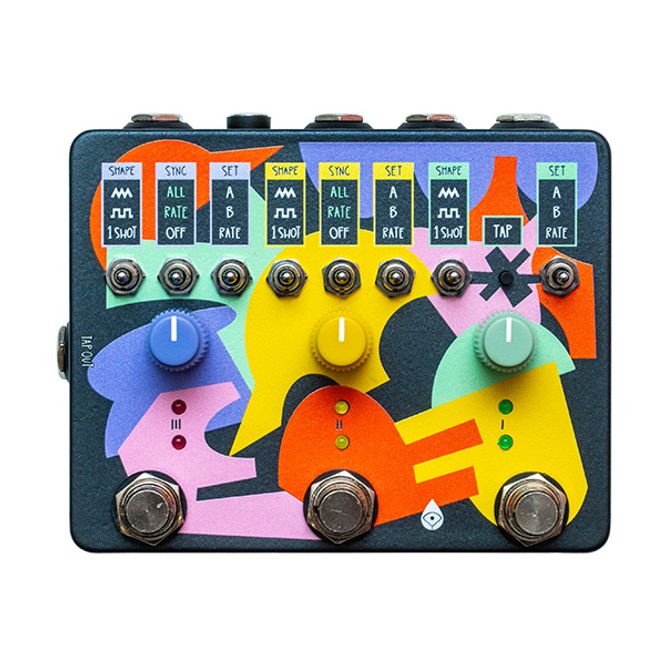
Old Blood Noise Endeavors Expression Ramper X3 Syncable Triple Expression Control with Presets Expanding on the concept of our Expression Ramper, we present the Expression Ramper X3, an expression movement shaper capable of manipulating three expression jacks simultaneously with copious control. This utility device brings new sounds out of your old favorites, reinvigorating the sonic possibilities of your collection. Main Features: • Expression Control Pedal, with storable expression preset settings • 3 expression separately adjustable and syncable outputs to create footswitch activated motion on up to three external devices • Ramp between the two presets (A and B) • 3 new random shapes (Smooth, Sharp and 1 Shot) in addition to the classic shapes (Triangle, Square, and 1 Shot) for movement between settings • Ability to sync across all three Rampers, with subdivided rate or direct output matching • Tempo syncing via tap switch on the device, external tap switch, and tap out in order to sync multiple Expression Ramper X3s • Expression input for Ramper 1, allowing X3 to become a 1-in-3-out Expression splitter • Rate control, sets the speed of movement • Configurable EXP output (TRS, TRS reverse polarity or TS) • LED indicates which setting is currently active • Smart footswitching for momentary or latching operation • Powered by regular 9 V DC PSU (centre -, 2.1 mm, ~50 mA current draw) A Ramper is a device that creates motion on your expression-enabled devices. You choose point A, point B, and the way it moves between. It’s utilitarian, but opens up a number of sounds from your existing pedals. The Expression Ramper X3’s allows you to set the shape of the LFO (the thing that determines the expression motion). There are three standard shapes (Triangle, Square and One Shot), and three random variations of those shapes. To access the alternative shapes, simply hold down the tap button while switching the Shape toggle. • Triangle, for a linear motion between A and B, starting and ending at A and hitting B at halfway on the LFO cycle. • Alternate shape: Smooth random, which repeatedly moves to a random spot between A and B in a linear fashion. • Square, to snap between A and B, spending half of the LFO cycle in each position. • Alternate shape: Sharp random, which immediately moves to a new random spot between A and B at the start of each cycle. • 1 SHOT, to move linearly either from A to B or B to A (depending on the starting point) and then stop. • Alternate shape: one shot random, where each press of the footswitch snaps to a new random spot between A and B. The device’s Footswitches set things in motion. A stomp of the footswitches will initiate motion according to the shape and LFO speed you’ve set, and another stomp will stop that motion. By holding a footswitch, you can momentarily stop or start the movement, and then revert to where you were before when that footswitch is let go. Most of the time, when not in motion, a Ramper will be in the A position, unless using one of the 1 Shot modes or currently setting the B position. To know where your Ramper is, use your ears as an auditory guide and the two LEDs as a visual guide. Expression Ramper X3 is more than three Rampers in one box, there are a plethora of additional controls to tempo sync multiple Rampers. The SYNC toggles on Rampers II and III determine whether they are synced to Ramper I. ALL syncs everything about the Ramper: the output of the completely synced Ramper will match Ramper I’s output exactly. RATE syncs only the rate of the Ramper: A, B, Shape, and motion settings stay independent, but the rate is tempo synced. In this setting, changing the Rate knob assigns subdivisions: 1⁄4, 1⁄2, 1x, 2x, 3x, and 4x speeds are all available. OFF deactivates any syncing, so the Ramper can act fully independently. Ramper I (the green one) has a TAP button. This can be used to tap in the desired LFO speed. It begins syncing at two taps, but multiple taps in a row at similar BPMs will average out to increase accuracy. Note: the slowest possible tap tempo is 30 BPM, so taps outside of this range will be disregarded. Ramper I also has external control via the jack. It can be used in three different ways, configurable via the internal dipswitch (located on the bottom right of the board, labeled “TAP/EXP SETTING”). It can be configured for TRS Expression input, External Tap Tempo with a footswitch, like our ‘Scooch’ Tap Tempo device using a TS cable and tap away. Or for External Tap Tempo using a pulse, turn 1 off, 2 off, 3 off. This is optimized to sync tempo across two ERX3s by plugging into the second ERX3's Tap Out jack, but will also work with other external pulse sources. There is also a TAP OUT jack on the side of Triple Ramper. This continually outputs 3.3V pulses based on Ramper 1’s tempo. In this way, you can sync external units (like another Expression Ramper X3) to Ramper 1. Happy Ramping!
Old Blood Noise Fault V2 ...

3.009,-

Fault V2 Overdrive & Distortion The Old Blood Noise Endeavors Fault is a stellar overdrive/distortion combo with a foot-switchable second gain stage and three band EQ. Now with the Fault V2, OBNE has taken all the goodness from the original pedal and carved out room for even greater gain ranges, voice control and additional clipping options. It’s simple and not an outside-of-the-box, whacky take on crunched-up guitar signal. No, Fault V2 does what it does - to provide the player with ample tonal and gain shaping options in a single package. Plus, the V2 pedal also excels as a clean boost and tweakable high gain distortion too. • Dual gain overdrive pedal - goes from clean boost to all-out distortion • 3-band EQ with sliders - delivers precise control over low, mid and high frequencies • Gain 2 channel - lets you go from light overdrive to heavy distortion on the fly • Boost switch - sets range of Gain 1 knob from clean to mean • Crush switch - add an additional post-EQ clipping stage • Relay bypass switching • Made in the USA • Powered by regular 9V DC PSU     (centre -, 2.1 mm, ~31 mA current draw) The Fault V2 Overdrive/Distortion is the drive you didn’t even know you needed. It can push your amp over the edge, provide a sensitive drive for a clean signal or act as an all-out distortion for your chugging rhythms, singing leads or noise experiments.  A Bypass switch turns it on and off. Volume makes it louder. Gain 1 sets the intensity of the first gain stage and Fault can go from light and sparkly, to tight and crunchy. Pretty sweet and simple, huh? Now on to the powerful tone sculpting 3-band EQ at the heart of it all. The Low, Mid and High controls each cut or boost their respective frequencies - scoop it, hump it, flatten it - whatever your heart desires. Low is a 100 Hz shelf filter, Mid is 500 Hz bell and High is 3 kHz shelf. Jangly rhythms, fat leads or chords with just the right amount of mid-push to see you push through the mix - it’s all in there! Gain 2 is activated by the Gain 2 footswitch. If it’s off or if the knob is all the way down, it does nothing. But turn the switch on and the knob up and you’ll find increasingly heavy distortion in a pedal you thought was only an overdrive. Gain 2 is highly interactive with where you’ve set Gain 1, letting you conjure a myriad of delightfully driven and distorted sounds. Add in the new controls - Voice (sets the overall tone of your drive heading into the 3 band EQ) and Boost (sets the range of Gain 1) and you get even more drive versatility. While the Crush control gives one final clipping stage right before the output. All of these options interact to form many different drive tones, from signal sweetening to aggressive distortion. Different levels of each will create different sounds, which when tweaked with the EQ can be further shaped. So just plug in, don’t be afraid to tweak and just rock out!
Old Blood Noise Flat Light ...

2.786,-

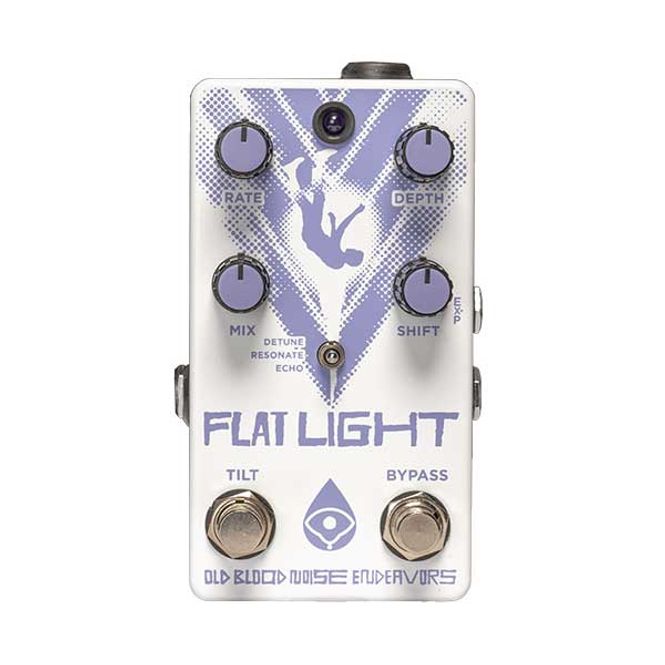
The Flat Light is a flanger aiming to be something else. It explores choral pitch shifted flanging, from octave down to a shimmering octave up and all the odd nooks and double-tones in between. Cascading lines form a lush modulation that becomes metallic and resonant as you push it. Reverb-like delays turn a stereotypical jet plane flange into more of an exploratory space mission. Push the controls and sense the terrain, yet trust your intuition—maybe not with your life, but with your sound. Textural flanger pedal – made for unique modulated textures 3 different flanger types – detune, Resonate and Echo Momentary Tilt switch – for expressive and ramping modulation sounds Expression in – control either Rate or Shift via an external expression pedal Made in the USA Powered by 9V DC PSU (9V DC, centre -, 2.1mm, ~60mA current draw) Building effects around a foundation of flanging, the Flat Light is a swirling spatial sonic experience you never want to leave once you turn it on. From simple pitch shifting flanging and highly resonant metallic sounds, to reverb-like delays and recognizable swooshes, the Flat Light will induce motion to your sound, no matter where it sits in your signal path. The Flat Light sports three different modes of flanging: Detune is a pitch shifted flanger where Shift ranges from an octave down (all the way to the left) to shimmering octaves up (all the way to the right), with a range of slightly detuned sounds in the middle. Resonate is a cascading set of flanger lines creates a highly resonant flanger where Shift controls the amount of feedback. At low settings, lush chorus-like sounds are available. At high settings, metallic ringing frequencies spike with your signal. Echo is a flanger with multiple delays added. Shift sets the time of the delay, with the longest times all the way to the right; all the way to the left eliminates the delay entirely. In this mode, flanger depth is fixed and Depth controls resonance. The Flat Light has two footswitches. Bypass is your standard on/off True Bypass switch, while the Tilt switch is momentary and when pressed will max out the control associated with the internal expression mode (Shift by default, but it can be changed to Rate). The expression input gives you control over either Modulation Rate or the Shift control (selectable via internal DIP switches) via an external expression pedal. This allows you to go from subtle chorus tones, to wide flange sweeps simply via your foot. The output level can be tweaked via an internal trim-pot for boost, slight drop, or unity gain.
Old Blood Noise FLOAT Dual ...

3.904,-

Old Blood Noise Endeavors FLOAT Dual Moving Filter A Re-envisioning of the Filter Effect Turning its predilection for parallel signals toward the world of filters and widening out to full stereo, Old Blood Noise Endeavors unveils its first digitally-controlled analog pedal. Float boasts two independently controllable filters and copious capabilities for motion. Utilising the two filters in tandem can create stereo movement, linked reactive elements, and modulations that approach harmonic tremolo and phaser, as well as classic filter sounds. Main Features: • Dual Moving Filter effects pedal • Two independent filters, each with control over filter type, cutoff frequency,   LFO rate, envelope sensitivity, LFO shape, resonance and volume • True stereo, parallel mono, or series mono operation via top-mounted jacks • Min/max toggle for precise sculpting of LFO and envelope range • Sync toggle to link the LFO or envelope elements of Filter 1 to Filter 2 • Expression jack to externally control Cut-off or Rate for each filter • Soft touch switching with true relay bypass • Hidden settings for LFO phase and envelope speed • Pedalboard friendly size • Made in the USA • Powered by 9V DC PSU           (centre -, 2,1 mm, ~100 mA current draw) Filters... could we improve upon a pedal genre we’d never participated in? Should we? Of course, we knew all about those sharp quacks and the smooth wows, plus the synth players among us knew the resonant sweeps. But, as our friends kept telling us, the slow dual motions, the controls that go a little more left than you expect, the parallel undulations and surely other corners were all left unexplored. So, turning our predilection for parallel signals toward the world of filters and widening out to full stereo, say hi to Float, our new Dual Moving Filter pedal. As OBNE’s first digitally-controlled analog pedal, Float boasts two independently controllable filters and copious capabilities for motion. Utilising the two filters in tandem can create stereo movement, linked reactive elements and otherworldly psychedelic modulations. The two independent filters can be set to either low pass, band pass or high pass. The core of each filter is its Cutoff Frequency, which can stay still or move via either its 6 different LFO shapes or through its dynamic Envelope triggering. The envelope sections can unleash quacky auto-wahs, shooting sonic laser beams or organically rising and falling filter landscapes - all triggered by your playing. While the LFOs lets Float become a mind-bending modulation device that can become everything from a phaser, a harmonic tremolo, a choppy or bubbly step-filter or an automated synth-like sweeper. However, skip the Modulation or envelope sections and the dual sliders come into play. This allows you to use Float as a dual-band EQ for subtle to extreme tone shaping, as a manual filter for on-the-fly futuristic filter sweeps or even for old-school wah-tones. Each filter also sports a resonance control, allowing you to unearth velvety smooth filters, vocal-like formants, screaming sonic squelches and anything in between. All of this is pretty familiar, but also pretty sweet. Like an amalgamation of all things filtery and good. But where things start to get really different and really fun is when you mess with the Sync and Routing of the two filters. By flicking that tiny toggle labelled Sync to On, the two filters will move like tonal twins - locked in, precise and uniform. This lets you create robotic sequencer-like textures, trippy dual modulations or ultra-long, yet perfectly timed, filter manoeuvres. You can also set it to Off and have them completely free-rolling for organically weaving textures or full-on filter cacophonies. In addition, the filters can be run in either parallel mono, series mono or stereo for all kinds of refined dual movements, cascading filter chaos or lush and dreamy stereo sweeps. To round off this veritable filter playground, we’ve added an expression in port, that lets you take hands-free control over either the cut-off frequency or LFO Rate, allowing you to keep your fluttery filter modulation as expressive as the music you play. So, that’s Float... or that’s the essence of Float. We’re sure you’ll unlock sounds from this thing we never knew it was capable of, because it does a lot of good, weird, wild, tame, ugly and absolutely stunning stereo stuff. Float on, friends!
Old Blood Noise Haunt 19 Fuzz ...

2.562,-

Fuzz Pedal - updated switches and sonic improvements. Haunt Fuzz The Old Blood Noise Endeavors Haunt is a gated fuzz that is capable of a wide array of fuzz sounds. From restrained and nuanced light fuzziness, to granular and biting saw sounds, many textures and character traits can be summoned up with this beastly fuzz pedal. Gated fuzz pedal – made for walls of ripping fuzz and unique spluttery textures 2 different fuzz modes – open or Compressed Clean blend via Mix control – retains string clarity and low-end response Made in the USA Powered by 9V DC PSU (centre -, 2.1mm, ~20mA current draw) The Haunt’s primary objective is to fight off your enemies with its gnarly grinding bite – or put your audience into sludgy, doomy ecstasy. Totally your choice, my riff-wielding friend. The Volume, Gate, Fuzz, Mix and Tone knobs give you access to a wealth of different dirt tones. From open, present and punishing sound to hyper-compressed and spluttery synth-like fuzz tones of doom and gloom. It’s all there and then some! The Haunt also has two toggle switches – Mode and Low. Mode switches between two combinations of silicon transistors. One is a lower volume, more compressed and harmonic fuzz (toggle to the left) and the other a louder, more open mid-range fuzz (toggle to the right). The Tone, Fuzz and Gate controls all respond in a unique way within each mode. So, mess around with it until you find exactly the fuzz you’re after. Low switches between a normal signal (toggle to the left) and a bass boosted signal (toggle to the right) and fattens the sound up a bit. Pair that bass boost with the clean-blend option of the Mix knob and you have a fuzz pedal that also plays extremely well with bass.
Viser 421 til 435 (av 725 produkter)
  • vipps-orange.png
  • klarna-light.png
  • mastercard-full.png
  • visa.png