Hopp til innhold

Norsk nettbutikk | Rask levering | Frakt i hele Norge

Nye produkter

Old Blood Noise Alpha Haunt ...

3.009,-

Alpha Haunt Fuzz - Highly-tweakable Fuzz Pedal with EQ. Alpha Haunt is a fuzz. OK that’s simple enough so far, but Alpha Haunt also has twelve (!!) highly interactive controls which mean things got a bit more involved now. Most of the fuzz buzzwords are here – huge and sustaining, gated and sputtering, mid scooped, mid boosted, bright, dark, clarity, utter lack of clarity and splatty. This is basically the fuzz motherlode being thrown at you and the whole pack is at your disposal. You are the alpha now. Highly tweakable fuzz pedal – endless worlds of fuzz at your disposal 3-band EQ sliders – perfect your place in the mix with full control over lows, mids and highs Clean blend via Enhance control – retains string clarity and low-end response Made in the USA Powered by 9V DC PSU (9V DC, centre -, 2.1mm, ~30mA current draw) Building and expanding on the classic Haunt Fuzz, one of Old Blood Noise Endeavors’ first sonic excursions, the Alpha Haunt explores the vast variety of sounds you can coax from a single fuzz circuit. With its extensive control set, the Alpha Haunt gives the user the ability to dial in a wide swath of fuzz textures – from wide open overdrives, squashed sputters to wild disintegrating synthy textures. The controls that truly set the Alpha Haunt apart from the large fuzz pack out there, are the ultra-powerful 3-band EQ sliders, Enhance, Bias and Gate knobs. Found a nice foundational fuzz sound in there you like, but feel you could use more string clarity? Turn up that Enhance knob, and hear the sweet ring of your clean tone get blended in parallel to the fuzz. This feature also means you have a fuzz pedal that plays extremely well with bass, synth, drum machines or whatever you may feel like throwing at it. You’ve got the sound, but you need to find your place in the mix? Well, those three big sliders to the right should do the trick then. Bring up the treble for biting and cutting stings of fuzz, or bring up the lows and mids to unleash the sonic sledgehammer and bring down the house. Crave more unique textures than just straight up fuzzstortion? Bring up the Gate and Bias and hear your sound compress, sputter, scream and swell up like a monster trying to break free of its sonic shackles. Perfect for synth-like sounds, velcro-esque rips and sputters or crumbling lo-fi tones. You’re fully in charge now of your fuzz sound. So, take control, lay waste to your fuzz foes and create a new fuzzy landscape, reborn around the immense powers and possibilities within the Alpha Haunt Fuzz.
Old Blood Noise Excess V2 ...

3.009,-

Old Blood Noise Endeavors Excess V2 Distorting Modulator A Marriage of Distortion and Delay-Based Effects Way back in 2017, Old Blood Noise Endeavors released their first venture into Distortion aligned with Delay-based effects. Aptly named Excess, we all thought it was fantastically excessive enough back then, but along comes 2022 and Old Blood Noise are adding more switches. Despite this, the controls are actually dead simple, but the sonic potential is immense! Expanding on the original model, Old Blood Noise Endeavors continues their journey to revive and expand sought-out sounds of the 80s. With delay, chorus and harmonized fifths available, along with distortion in series or parallel configurations, Excess V2 unveils more unique tones and even more control, yet all in a smaller more pedalboard friendly package. Main Features: • Distortion and Modulation pedal • Three modes of modulation (Delay, Chorus and Fifth) each with Time, Depth, and Volume controls • Distortion section with control over Gain, Tone and Volume to access light overdrive through fuzzy distortion • Order switching to run Distortion into Modulation, Modulation into Distortion, or separate parallel paths • Soft touch switching and true relay bypass for each section • Expression jack to externally control Rate and Depth • Internal trimpot to set wet-dry mix of Modulation section • Made in the USA • Powered by 9V DC PSU (centre -, 2.1mm, ~125 mA current draw) Simply put, Excess V2 is two effects in one: a distortion and a modulation. The modulation takes the form of chorus, delay or pitch shifted delay and the way you route and engage them makes all the difference. Each mode has its own footswitch to engage or disengage the sound. We’re thinking about circuits from the 80s, 90s, today and a little bit earlier, all helping to create tones you’ve never thought of before! Excess V2 features three modes of modulation. Fifth is a harmonized delay and harmonizes the delay repeat up to a perfect fifth. When depth is turned up (adding delay repeats), those repeats continue to harmonize upward, creating rising fifths and octaves from your original note. Chorus offers a classic chorus, modulating the delay line to create swirling sounds. Delay is a short delay (up to 125ms) focused on comb filter, doubling, and slapback sounds. This section features three knobs, Mod Vol which controls the volume of the modulation, from zero to loud, Rate controls the rate or time of modulation (either the speed of the chorus LFO or the delay time of the delay) and Depth adjusts the depth or feedback of modulation (either the width of the chorus LFO or the number of repeats of the delay). The Distortion section also has three knobs. While Dist Vol controls the volume of the distortion, from zero to loud, Tone controls the high end of the distortion, from dark to bright. Gain adjusts the gain of the distortion, from bright and almost clean to heavily distorted. There are three ways of routing the effects in the Excess V2: • Mod 1st runs modulation into distortion, creating harmonically rich and sometimes almost out of control textures. Because the effects are in series, if either volume control is all the way down, you will get no signal.   • Parallel runs modulation and distortion side by side, which allows for clean modulated signal alongside distorted signal.  This mode has a natural volume boost due to the signals being added together. Blend to taste with the volume knobs and find some unfamiliar wet-dry textures.   • Dist 1st runs distortion into modulation, which is a classic way of routing these two effects, allowing for crisp repeats and modulations of your distorted sound. Because the effects are in series, if either volume control is all the way down, you will get no signal. Internally the Excess V2 has a hidden trimpot located above the expression jack that sets the mix of the modulation section. By default, it is set for a 50-50 mix of dry and wet, allowing for classic chorus and unity volume delay repeats. To increase the mix, turn to the right: this can go 100% wet (affected signal) for true pitch vibrato and strange delay textures. To decrease the mix for more subtle modulation, turn to the left: this can go 100% dry (unaffected) leaving only clean signal on the modulation side. For even more creativity, the Expression jack can be used to externally control the Rate and Depth knobs. To use it, plug an expression device in using a TRS cable (we recommend the OBNE Expression Slider or Expression Ramper) or any other expression device wired as TRS with tip as the voltage output.
Old Blood Noise Fault V2 ...

3.009,-

Fault V2 Overdrive & Distortion The Old Blood Noise Endeavors Fault is a stellar overdrive/distortion combo with a foot-switchable second gain stage and three band EQ. Now with the Fault V2, OBNE has taken all the goodness from the original pedal and carved out room for even greater gain ranges, voice control and additional clipping options. It’s simple and not an outside-of-the-box, whacky take on crunched-up guitar signal. No, Fault V2 does what it does - to provide the player with ample tonal and gain shaping options in a single package. Plus, the V2 pedal also excels as a clean boost and tweakable high gain distortion too. • Dual gain overdrive pedal - goes from clean boost to all-out distortion • 3-band EQ with sliders - delivers precise control over low, mid and high frequencies • Gain 2 channel - lets you go from light overdrive to heavy distortion on the fly • Boost switch - sets range of Gain 1 knob from clean to mean • Crush switch - add an additional post-EQ clipping stage • Relay bypass switching • Made in the USA • Powered by regular 9V DC PSU     (centre -, 2.1 mm, ~31 mA current draw) The Fault V2 Overdrive/Distortion is the drive you didn’t even know you needed. It can push your amp over the edge, provide a sensitive drive for a clean signal or act as an all-out distortion for your chugging rhythms, singing leads or noise experiments.  A Bypass switch turns it on and off. Volume makes it louder. Gain 1 sets the intensity of the first gain stage and Fault can go from light and sparkly, to tight and crunchy. Pretty sweet and simple, huh? Now on to the powerful tone sculpting 3-band EQ at the heart of it all. The Low, Mid and High controls each cut or boost their respective frequencies - scoop it, hump it, flatten it - whatever your heart desires. Low is a 100 Hz shelf filter, Mid is 500 Hz bell and High is 3 kHz shelf. Jangly rhythms, fat leads or chords with just the right amount of mid-push to see you push through the mix - it’s all in there! Gain 2 is activated by the Gain 2 footswitch. If it’s off or if the knob is all the way down, it does nothing. But turn the switch on and the knob up and you’ll find increasingly heavy distortion in a pedal you thought was only an overdrive. Gain 2 is highly interactive with where you’ve set Gain 1, letting you conjure a myriad of delightfully driven and distorted sounds. Add in the new controls - Voice (sets the overall tone of your drive heading into the 3 band EQ) and Boost (sets the range of Gain 1) and you get even more drive versatility. While the Crush control gives one final clipping stage right before the output. All of these options interact to form many different drive tones, from signal sweetening to aggressive distortion. Different levels of each will create different sounds, which when tweaked with the EQ can be further shaped. So just plug in, don’t be afraid to tweak and just rock out!
Old Blood Noise Flat Light ...

2.786,-

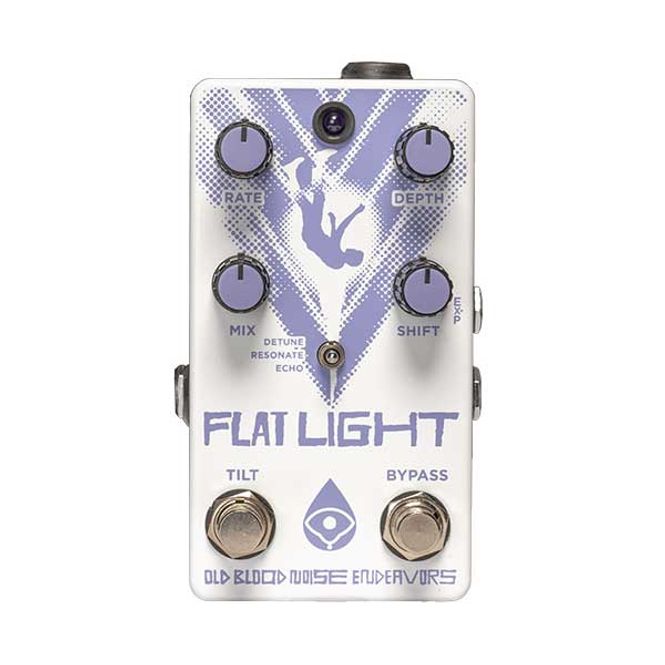
The Flat Light is a flanger aiming to be something else. It explores choral pitch shifted flanging, from octave down to a shimmering octave up and all the odd nooks and double-tones in between. Cascading lines form a lush modulation that becomes metallic and resonant as you push it. Reverb-like delays turn a stereotypical jet plane flange into more of an exploratory space mission. Push the controls and sense the terrain, yet trust your intuition—maybe not with your life, but with your sound. Textural flanger pedal – made for unique modulated textures 3 different flanger types – detune, Resonate and Echo Momentary Tilt switch – for expressive and ramping modulation sounds Expression in – control either Rate or Shift via an external expression pedal Made in the USA Powered by 9V DC PSU (9V DC, centre -, 2.1mm, ~60mA current draw) Building effects around a foundation of flanging, the Flat Light is a swirling spatial sonic experience you never want to leave once you turn it on. From simple pitch shifting flanging and highly resonant metallic sounds, to reverb-like delays and recognizable swooshes, the Flat Light will induce motion to your sound, no matter where it sits in your signal path. The Flat Light sports three different modes of flanging: Detune is a pitch shifted flanger where Shift ranges from an octave down (all the way to the left) to shimmering octaves up (all the way to the right), with a range of slightly detuned sounds in the middle. Resonate is a cascading set of flanger lines creates a highly resonant flanger where Shift controls the amount of feedback. At low settings, lush chorus-like sounds are available. At high settings, metallic ringing frequencies spike with your signal. Echo is a flanger with multiple delays added. Shift sets the time of the delay, with the longest times all the way to the right; all the way to the left eliminates the delay entirely. In this mode, flanger depth is fixed and Depth controls resonance. The Flat Light has two footswitches. Bypass is your standard on/off True Bypass switch, while the Tilt switch is momentary and when pressed will max out the control associated with the internal expression mode (Shift by default, but it can be changed to Rate). The expression input gives you control over either Modulation Rate or the Shift control (selectable via internal DIP switches) via an external expression pedal. This allows you to go from subtle chorus tones, to wide flange sweeps simply via your foot. The output level can be tweaked via an internal trim-pot for boost, slight drop, or unity gain.
Old Blood Noise Haunt 19 Fuzz ...

2.562,-

Fuzz Pedal - updated switches and sonic improvements. Haunt Fuzz The Old Blood Noise Endeavors Haunt is a gated fuzz that is capable of a wide array of fuzz sounds. From restrained and nuanced light fuzziness, to granular and biting saw sounds, many textures and character traits can be summoned up with this beastly fuzz pedal. Gated fuzz pedal – made for walls of ripping fuzz and unique spluttery textures 2 different fuzz modes – open or Compressed Clean blend via Mix control – retains string clarity and low-end response Made in the USA Powered by 9V DC PSU (centre -, 2.1mm, ~20mA current draw) The Haunt’s primary objective is to fight off your enemies with its gnarly grinding bite – or put your audience into sludgy, doomy ecstasy. Totally your choice, my riff-wielding friend. The Volume, Gate, Fuzz, Mix and Tone knobs give you access to a wealth of different dirt tones. From open, present and punishing sound to hyper-compressed and spluttery synth-like fuzz tones of doom and gloom. It’s all there and then some! The Haunt also has two toggle switches – Mode and Low. Mode switches between two combinations of silicon transistors. One is a lower volume, more compressed and harmonic fuzz (toggle to the left) and the other a louder, more open mid-range fuzz (toggle to the right). The Tone, Fuzz and Gate controls all respond in a unique way within each mode. So, mess around with it until you find exactly the fuzz you’re after. Low switches between a normal signal (toggle to the left) and a bass boosted signal (toggle to the right) and fattens the sound up a bit. Pair that bass boost with the clean-blend option of the Mix knob and you have a fuzz pedal that also plays extremely well with bass.
Old Blood Noise MAW ...

4.128,-

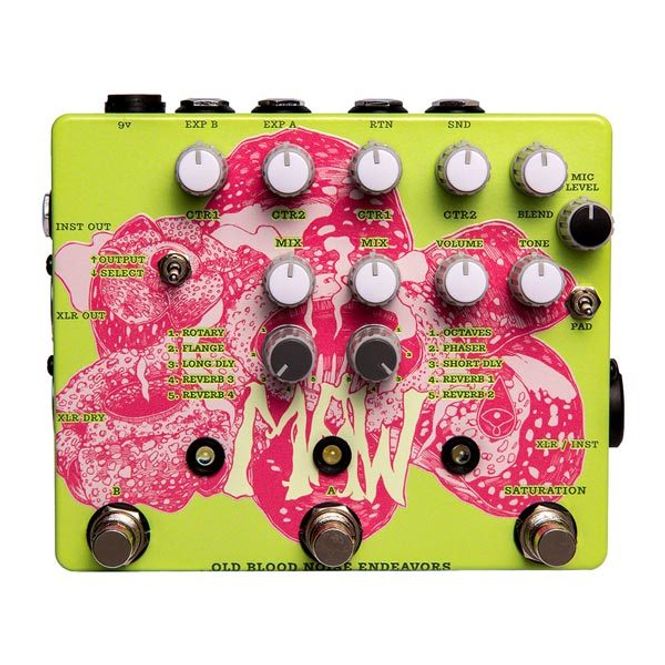
MAW Microphone Effects Manipulator Originally conceived as a simple effects pedal for vocalists, the MAW is a fully functional pedal for any application that involves a dynamic microphone. Featuring a high-quality microphone preamp fed into three foot-switchable effect engines and an effects loop for integrating you own favourite external effects, MAW is both perfect as a versatile tool for studio tinkerers or it can be an all-in-one for creative vocalists looking to control their live sound. MAW can saturate, reverberate, delay, flange and rotate your signal with the three on-board effects sections, plus you can integrate additional effects pedals with the send/return loop for a world of other creative uses. This is also perfect to patch in other pedals and effects that you may already have, which traditionally wouldn’t be able to be hooked up to a microphone directly. Both a microphone audio workstation and a poetic tool, MAW likes an XLR signal but will take a 1/4” jack input too. Multiple outputs and expression control finish out this versatile toolkit. Let its voice become yours. Vocal Effects Pedal XLR Microphone preamp for dynamic microphones Microphone gain control with pad switch for hot signals Tone knob – low pass filter for darker or brighter tone Switchable saturation section, with blend and tone knobs to sculpt your tone Two foot-switchable multi-effects engines: First – two reverbs, short delay, phaser, lower and upper octaves Second – two additional reverbs, long delay, flanger and rotary Momentary or Latching Switching – for seamless effects changes on the fly FX Loop – add your own effects pedals into its signal chain Effects trails – allows natural Reverb and Delay decay External Expression Control – for each effects section 1/4”/6.5mm instrument cable input Dual outputs: Wet – switchable between 1/4”/6.5mm or XLR Post-saturation Dry – XLR Powered by regular 9 V DC PSU (centre -, 2.1mm, ~210mA current draw)
Old Blood Noise Minim Reverse ...

3.588,-

Minim – Reverse Delay and Reverb Immediate Ambient Machine Time. Although always moving inevitably forward, it can often feel like it’s standing still in an undulating haze. Sometimes it even feels like it’s moving backwards, making us revisit and learn from our past. These meditative moments in time is where you’ll find the Old Blood Noise Endeavors Minim and its infinitely modulating soundscapes. So, whether you want standard delay/reverb, reverse reverberations, or pulsating circular sonic movements, Minim is here to let you shape and bend time as you please. Creative Modulated Reverb and Delay Pedal (up to 400 mS) Reverse section – activated with a clever footswitch for momentary or latching operation Order switching – puts reverse first in the chain for ambient wash or last in the chain for glitchy textures Expression jack – for external control of the Reverse mix Internal trimpot to control output level Relay bypass switching Powered by regular 9 V DC PSU (centre -, 2.1mm, ~159mA current draw) Inspired by the foundational features of OBNE’s last ambient smash-hit, the Rêver, Minim is set to instantly transport you even further to new atmospheric worlds, through its organic control set. Think of Minim as having two blocks. One block takes whatever signal is given to the pedal and reverses it at the press of a footswitch, while the other block gives you modulated reverb, fed into a modulated delay. Plus, there’s even a switch that decides which block comes first. Each control is simple, but put them all together and you’re likely to lose all sense of time. The reverb side of things lets you create everything from simple room reflections to deep and endlessly trailing ambient washes, via Minim’s Mix and Decay controls, while the Mod knob lets you blend in a gently swaying harmonic tremolo to put some waves into your ocean of sound. On the delay side, you’ll find the Time and Feedback controls to be pivotal tone shapers. Time both controls the length of the delay (up to 400ms) as well as the modulation amount, giving you sweet shimmering chorus tones at low settings and warbly tape-like vibratos at long settings. Feedback will go from a single repeat to endlessly cascading echoes for beds of blissful ambience. All of this wonderful ambience that’s created by the reverb and delay side can then be further manipulated by the momentarily triggered reverse section, seeing you instantly reverse everything on the fly, in order to make lines, phrases or entire chord progressions stand out in all its glorious shoegazy goodness. The mix of the reverse can either be fixed via the Reverse dial or instantly shaped and changed hands-free via an expression pedal. On top of that, you can flip the order of the reverse block. This gives you the choice between smooth reverse effects or choppy glitchy textures, as well as change the reverse speed from normal to double time for unique stutter octave tones. As you can probably gather by now, Minim isn’t just one thing. It’s an amalgamation of spatial effects, set to work together with you and your musical mind in order to create organically evolving sonic atmospheres. So free your mind and let the Minim unleash your new-found ambient potential.
Old Blood Noise Signal ...

4.299,-

Signal Blender Stereo Parallel Effects Chain Creator Multi Stereo Loop Pedal, Holey Kids finish Since its release in 2019, OBNE’s Signal Blender has become an indispensable tool for musicians looking to create parallel signal chains, or otherwise split or combine multiple signals. Now, in collaboration with 29 Pedals, the new Signal Blender Stereo boasts many worthwhile and useful upgrades from the original version. When 29 Pedals approached OBNE about improving the signal headroom and phase response of the original version for use in their own studio, a collaboration was born. Not content with only signal improvements, the team approached the whole new design in stereo, added trails switching and also added MIDI switching for integration into more complex rigs. Main Features: • Mono or Stereo Parallel Effects Chain creator • Designed in collaboration with 29 Pedals • Stereo input and output, with two Stereo Effect Loops • Option for Mono-to-Stereo splitting at the main input • Individual volume knobs and footswitches for Loop A, Loop B and Clean Signal • Trails switching for Loop A and Loop B • MIDI control of on/off and trails switches • Options for True Bypass when all switches are off • Top-mounted jacks and Soft-Touch Switching • Hand-made in Oklahoma, USA • Powered by (opt.) 9 V DC PSU, scaled up to +/- 15V internally (centre -, 2.1mm, ~ 500 mA current draw, not included) Signal Blender Stereo is a comprehensive mono or stereo parallel effects chain creator. From the input, your signal forks out into multiple paths, allowing parallel blending of two effects loops (A and B) and the original input (Clean) at the output. Experience the joys of parallel routing, or expand to other use cases, like splitting a signal to three separate outputs, or combining three unique signals into one output. The simple, yet fully featured control set allows for grab-and-go utilitarianism. The A and B switches engage their relevant effects loop. Tap it to latch the on/off state, or hold it for momentary action. Signal is sent at full strength through the Send jack and the volume knob determines the amount of signal coming back into Signal Blender Stereo via the Return jack. The phase invert toggle allows phase inversion on the return when the toggle is in the up position, accounting for pedals that flip the phase. The trails toggle in the up position prevents the Return from switching off, allowing time-based effects to trail after the footswitch is switched off. In the down position, the send and return are switched on and off together. The Clean footswitch determines whether the original clean input signal is sent to the main output and the Clean volume knob determines the volume of that signal when engaged. By default, Signal Blender is designed to be stereo through the use of TRS cables, or mono through the use of TS cables, without the need to change any settings at all on the device. However, if mono input to stereo output is desired, just use the internal dipswitch to assign mono-in-stereo-out (“MISO”), then use a TS cable at the input and TRS cables everywhere else.
SolidGoldFX If 6 Was 9 MkII ...

2.562,-

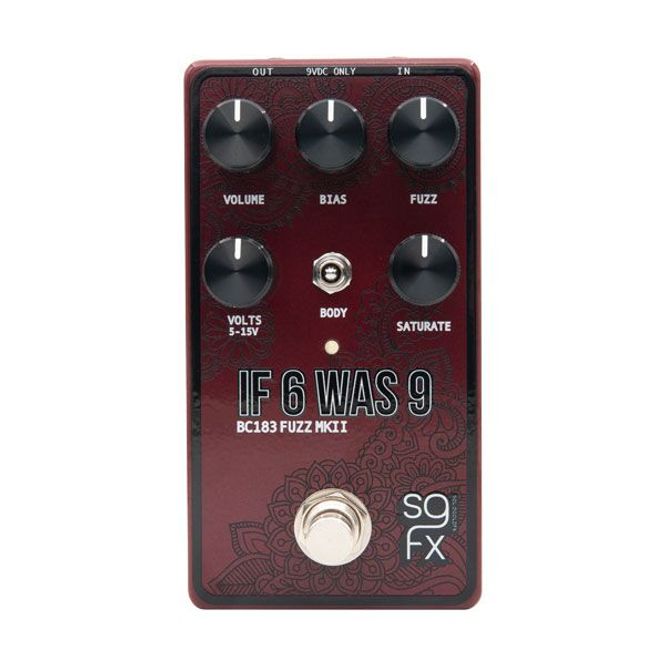
If 6 Was 9 MKII BC183 Silicon Fuzz If there’s one pedal that captures the history of sonic rebellion and the soul of classic rock, then the Fuzz Face is it. Bold and raunchy when fed power chords, velvety smooth and angelically soaring when presented with lead lines and with an almost too-good-to-be-true volume knob cleanup, which allows for the best clean tones you’ve ever heard, the Fuzz Face is truly a multi-faceted tonal treasure. Jimi Hendrix, Eric Johnson, Stevie Ray Vaughan and Pete Townsend all carved their undying legacy with this iconic fuzz machine and with our If 6 Was 9 MKII, you can instantly tap into those legendary tones or go far beyond to discover your own saturated signature sound. Main Features: • Silicon Fuzz pedal • Based on the Dallas-Arbiter Fuzz Face circuit • Uses two BC183 transistor – for soulful fuzz tones between mushy compression of Germanium and brash sound of Silicon • Variable voltage pump supplies power between 5 to 15VDC internally • Thick balanced bass response and tight fuzz tone • Tone toggle switch chooses between tight and thick fuzz voicings • Bias knob for varying the operational voltage – for a huge range of tones from compressed and nasty to big and bold Saturation control trims the circuits input for better cleanup or impedance matching • Soft-touch True bypass switching and top-mounted jacks • Hand-made in Montreal, Canada • Powered by opt. 9V DC PSU (centre -, 2,1 mm, 20 mA current draw) It’s been at least 10 years since we launched our original If 6 Was 9 BC183 and improving on this solid design was no small feat. SGFX’s pedal pays tribute to all the players who contributed to the pantheon of rock, with specially selected components to get your mojo working. We put two BC183 devices in each one, which is widely regarded as a happy medium between the potentially mushy compression of germanium and the brash sawmill-like fuzz of silicon. The tone of the If 6 Was 9 MKII is just that - smooth and refined, without falling apart on chords and with loads of sustain on single-note work. The MKII includes all the soulful fuzz tones of the original BC183, but incorporates a variety of new features aimed at bringing this vintage inspired design into the modern age. What really sets the new If 6 Was 9 MKII apart is the power supply. Fuzz Face tone has been whittled down to such a precise science that players now know what voltage at which they prefer their Fuzz Face to be run. Eric Johnson famously kept a box full of batteries drained to various degrees. We have equipped this fuzz with a variable voltage pump, supplying anywhere from 5 to 15VDC from a single 9V power source. No need for a box full of questionable batteries anymore, just set the knob to your preferred supply voltage and get as much fuzzy compression or meaty breakup you desire consistently, every time. This, in conjunction with the bias control, will allow for any shade of fuzz ranging from gated and sputtery, to smooth and dynamic, then all the way to bold and punchy. The new saturate control trims the circuit’s input for better cleanup, signal chain integration or impedance matching, ideal for use with a wah pedal. Finally, soft-touch true bypass switching and top jacks really bring this fuzz face into the 21st century. That was a lot of tech babble, we know. At the end of the day If 6 Was 9 MkII is just here to help you with what you do best: plugging in and rocking out!
SolidGoldFX 76 Octave Fuzz ...

1.479,-

2.490,-

76 Octave-up Fuzz. NB! Tilbudspris gjelder kun 1 stk. igjen på lager! While the Western world was preoccupied with its Fuzz Faces, Tone Benders and others, the Eastern world was bubbling up with plenty of fuzzes of its own. This very distinct era in fuzz history gave us many treasures that have been crowned fuzz legends—the Univox Super Fuzz, Ibanez Standard Fuzz, Ace Tone Fuzz Master, Shin-Ei Companion and several others. Our 76 offers up a comprehensive guided tour to the best that the Standard Fuzz and its ilk has to offer without any of the drawbacks, such as a quiet signal or fragile wiring. On its face, the 76 gives you a multi-voiced germanium-equipped fuzz unit that gives you hints of octave-up snarl while it ruthlessly pummels your amp with hair and fangs. Aside from standard volume and fuzz controls, and unlike the original Standard Fuzz, the 76 also gives you a texture control that sweeps the midrange, effectively giving you many flavors of fuzz across several positions. A three-way color switch offers a little frequency scoop, but the center position is off, for full-frequency fuzz madness. The internals contain two DIP switches that alter the character of the unit. The first, clip, changes the clipping stack from the stock Standard Fuzz arrangement of two germaniums into a hybrid germanium-silicon arrangement. Engaging this switch opens the sound up, increases crunch and definition for a searing lead tone. The other switch, Dark, engages a treble cut on the input, which helps to prep the incoming signal for the fuzz onslaught. This switch should be engaged if the 76 follows a bright dirt pedal or a jangly set of pickups. The new Standard Fuzz is here and is a forced to be reckoned with, leveling audiences with its punishing buzzsaw grind and unbridled harmonics. The 76 is your favorite fuzz nerd’s favorite fuzz.     KNOBS: Fuzz: Turning the Fuzz up ranges from a little crunch to more gain than you could ever want. Texture: This control adjusts the mid frequency of the 76. Go from a deep scoop to a mid-drenched grind with a simple twist Level: Adjusts the output volume, with more than enough on tap. TOGGLE SWITCHES: Color: Switches between three different frequency ranges, from scooped to full-frequency fuzz tones. UNDER THE HOOD: Clip (internal DIP): When on, the 76 employs germanium diodes for a spongier signal and a harder clipping threshold. When off, a silicon-germanium combo is employed, opening the fuzz signal up a little more. The default is on. Dark (internal DIP): When on, the 76 cuts a good amount of treble from the input signal, useful for single-coils and wicking away treble from anything before it. When off, the treble cut is lifted. The default is off. AUXILIARY: Input: Instrument or other pedal goes here. Output: Amplifier or other pedal goes here. True bypass footswitch: Turns effect on and off. POWER: The 76 requires a center-negative 9VDC power adapter with at least 5mA of current (not included). Almost all power supplies meet this requirement. DIMENSIONS: 4.77" x 2.6 x 1.39" (121.1 x 66 x 35.3mm)
Viser 2131 til 2140 (av 3692 produkter)
  • vipps-orange.png
  • klarna-light.png
  • mastercard-full.png
  • visa.png