Hopp til innhold

Norsk nettbutikk | Rask levering | Frakt i hele Norge

Nye produkter

Kali Audio LP-6 V2 Aktiv ...

2.340,-

LP-6 V2 Black Studiomonitor 6". Svart Versjon 2 av suksessmonitoren Kali LP6. Studiomonitor med 6,5’’ basselement og 1’’ Soft Dome-diskant. 80W (40+40) Klasse-D forsterker. LP6 V2 er og forbedret med 12db lavere egenstøy (self noice) og input er øket med 3db. EQ'en i nye LP6 V2 er og forbedret. Svart finish. Project Lone Pine Studio Monitors Version 2 The new LP-6 V2 is part of Kali’s 2nd Wave of loudspeakers. 2nd Wave products draw on 3 years of R&D for across-the-board improvements. A new amplifier platform allows for 12 dB less self noise, while input sensitivity has been increased by 3 dB. The tuning has been refined for smoother HF response, and the boundary EQs have been updated to reflect common real-world use cases. Physical improvements include lighter transducer cones for better transient response and upgraded cabinet construction for greater reliability.   Transparent Sound The Lone Pine Series is designed to allow you to hear every detail that's happening in your mix. This starts with an exceptionally accurate frequency response. Whatever is present on your mix is what you'll hear in these monitors. Nothing is boosted or suppressed to cover flaws or try to sound more pleasing. With the LP-6 and LP-8, you can mix with more confidence, and you can also be assured that your mix will translate as best as possible to whatever systems your audience is using. 3-D Imaging Waveguide The waveguide on Project Lone Pine monitors allows you to hear spatial details and a soundstage that is wider, taller, and deeper than the space between the speakers themselves. High dynamic range, low distortion The dual layer, large diameter voice coil on the LP-Series helps keep the sound clear and free of distortion. Low noise port tube The LP-6 and LP-8 both have the clean, punchy bass of a front-ported speaker with very low noise from the port tube. High Output At continuous reference-level output, the LP-Series monitors have at least 20 dB headroom at the listening position. The LP-6 has enough output for most 1-2 person setups, and LP-8 can handle larger setups easily. Ample headroom ensures that even loud mixes with high dynamic range will come through clearly.   Bass Power  Bass on the LP-Series monitors is delivered by larger magnets and larger voice coils than any comparable speakers on the market. This gives you more accurate bass response that extends lower, so you can dial in exactly the low end sound you need.  Boundary EQ Control A speaker's given position in a space can drastically change it's frequency response. A speaker placed against a wall or on a desk will sound very different than a speaker placed on a stand, even in a well-treated space. Hard surfaces like walls, desk tops, and recording consoles can change the low end frequency response of the monitor, and degrade the overall clarity of the sound. Happily, most of the common positions are fairly predictable and easily corrected.  Kali's team did our Boundary EQ tuning at The Village Studios in Los Angeles, and came up with boundary compensation EQ settings to help you get the optimum sound for where you need to put your speakers. Combined with the LF and HF trims, this will ensure that the speakers sound their best no matter what room you're mixing in, or where the speakers are placed. Easy Connections The LP-6 and LP-8 both feature balanced XLR and TRS inputs, and an unbalanced RCA input. The RCA input can be set to -10 dBu sensitivity when you're using consumer devices like a laptop or smartphone's headphone jack.  Class D Power The integrated Class D Power amp delivers clean, reliable power that's optimized to this speaker. Both models use 40W for the 1" soft dome tweeter. The LP-6 uses 40W for the 6.5-Inch woofer, and the LP-8 uses 60W for the 8-Inch woofer. - Aktiv 2-väg - 80W (40+40) Class-D förstärkare - 6,5" baselement - 1" Soft Dome-diskant - Frekvensåtergivning (-10 dB): 39 Hz - 25 kHz - Frekvensomfång (± 3 dB): 47 Hz - 21 kHz - Delningsfrekvens: 1,5 kHz - Max SPL: 112 dB - Obalanserad ingångar: 1x RCA - Balanserade ingångar: 1x TRS och 1x XLR - TRS/XLR ingångskänslighet: +4 dB - RCA ingångskänslighet: -10 dB - HF Trim: -2 dB, ±0 dB, +2 dB - LF Trim: -2 dB, ±0 dB, +2 dB
Kali Audio IN-8 V2 W Aktiv ...

4.290,-

Kali Audio IN-8 V2 White 3-veis Co-Axial studiomonitor med 8’’ basselement, 4’’ mellomtone og 1’’ Soft Dome-diskant. 140W (60+40+40) Class-D forsterker. Versjon 2. Hvit. _____ Project Independence Kali’s IN-8 V2 is one of the most innovative studio monitors ever made. Combining the natural advantages of a 3-way design with hyper-realistic imaging of a co-axial mid-range and tweeter, it offers more transparency, lower distortion, and a soundstage that must be heard to be believed. Performance Power. Detail. Soundstage. The IN-8 V2 Studio Monitor is a speaker like no other. Using the same woofer and tweeter from Kali’s celebrated LP-8, the IN-8 V2 adds a midrange driver that surrounds the tweeter, and acts as its waveguide.   In doing so, both the tweeter and the woofer are unburdened; with a smaller workload, they are able to play more clearly and with less distortion. The coaxial nature of the midrange and tweeter make the IN-8 an acoustic point source. Off-axis lobing is thereby eliminated, resulting in a stereo soundstage that presents the listener with a hyper-realistic level of detail. All of this means that the IN-8 is extremely accurate and easy to mix on, and that mixes made on the IN-8 will transfer wonderfully to other systems. Imaging We know. We keep harping on about the “hyper-realistic” imaging of the IN-8 V2. What does that mean? When you listen to a stereo set of speakers, you’re hearing information about where instruments and players were placed when the material was recorded. Even with purely digital material, producers can manipulate physical locations of elements in the mix, and you will hear these on a stereo recording. Not only does this allow producers to create interesting spatial effects, but it means that you can work faster and with more confidence. An accurate soundstage lets you “see” each element of the mix in front of you, so you can hear exactly what happens when you make changes. 2-way systems with good waveguides, like Kali’s LP-6 and LP-8, do a good job at conveying this spatial information. However, because the tweeter and woofer on those speakers (and most studio monitors!) are separate, this information gets lost in the space immediately above and below the speaker. This means that at the listening position, you’re not hearing the full stereo picture. The IN-8 solves this problem. The tweeter and midrange share an acoustic center, and the woofer is crossed over at 330 Hz, so the distance between the woofer and midrange is well under a quarter wavelength at the crossover point. This means that the IN-8 is acoustically a point source. As such, it has the same excellent directivity that the LP-6 and LP-8 have at their sides in a full 360 degrees around the speaker. You’re hearing all of the spatial information at the listening position, so the soundstage that you hear will have every detail that’s present in the mix. Clarity The IN-8 V2’s total harmonic distortion is less than 1.4%, which is exceptional. This is the result of unburdening both the woofer and the tweeter, so that both are doing less work. The woofer is crossed over at 330 Hz, a full 2.5 octaves lower than on the LP-8. The tweeter is crossed over at 3000 Hz, nearly an octave higher than on the LP-8. Taking up the space in between in the hero of the IN-8 system: the 4-Inch, profile-optimized midrange driver. This driver has a lot of work to do. In addition to reproducing midrange frequencies, it also acts as the waveguide for the tweeter. This means that the shape needed to be precisely engineered to provide an ideal dispersion characteristic for the tweeter. It also means that the midrange needs to stay still. In many other co-axial or concentric systems, high excursion from the larger driver causes intermodulation distortion, and degrades the accuracy of the system. The midrange on the IN-8 is limited to less than 1 millimeter peak excursion, making it acoustically stationary while still providing midrange to keep up with the powerful woofer and tweeter. Boundary EQ Control A speaker’s given position in a space can drastically change it’s frequency response. A speaker placed against a wall or on a desk will sound very different than a speaker placed on a stand, even in a well-treated space. Hard surfaces like walls, desk tops, and recording consoles can change the low end frequency response of the monitor, and degrade the overall clarity of the sound. Happily, most of the common positions are fairly predictable and easily corrected. Kali’s team did our Boundary EQ tuning at The Village Studios in Los Angeles, and came up with boundary compensation EQ settings to help you get the optimum sound for where you need to put your speakers. Combined with the LF and HF trims, this will ensure that the speakers sound their best no matter what room you’re mixing in, or where the speakers are placed. Easy Connections The LP-6 and LP-8 both feature balanced XLR and TRS inputs, and an unbalanced RCA input. The RCA input can be set to -10 dBu sensitivity when you’re using consumer devices like a laptop or smartphone’s headphone jack. Specifications - Powered: Yes - Amp Class: D - Power Config: Tri-Amped - LF Power: 60 W - Mid-Range Power: 40 W - HF Power: 40 W - Total Power: 140 W - LF Driver: 8-Inch Poly-Coated Paper - Mid-Range Driver: 4-Inch Optimized Profile Poly-Coated Paper - HF Driver: 1-Inch Textile Dome - Freq. Response (-10 dB): 37 Hz - 25 kHz - Freq. Range (±3 dB): 45 Hz - 21 kHz - LF to Mid-Range Crossover: 330 Hz - Mid-Range to HF Crossover: 3000 Hz - Listening Distance: 2.8 Meters - Max SPL: 114 dB
Kali Audio IN-8 V2 B Aktiv ...

4.190,-

IN-8 V2 Black 3-veis Co-Axial studiomonitor med 8’’ basselement, 4’’ mid og 1’’ Soft Dome-diskant. 140W (60+40+40) Class-D forsterker. Versjon 2. Svart finish. Project Independence Kali’s IN-8 V2 is one of the most innovative studio monitors ever made. Combining the natural advantages of a 3-way design with hyper-realistic imaging of a co-axial mid-range and tweeter, it offers more transparency, lower distortion, and a soundstage that must be heard to be believed.   Performance Power. Detail. Soundstage. The IN-8 V2 Studio Monitor is a speaker like no other. Using the same woofer and tweeter from Kali’s celebrated LP-8 V2, the IN-8 V2 adds a midrange driver that surrounds the tweeter, and acts as its waveguide. In doing so, both the tweeter and the woofer are unburdened; with a smaller workload, they are able to play more clearly and with less distortion. The coaxial nature of the midrange and tweeter make the IN-8 V2 an acoustic point source. Off-axis lobing is thereby eliminated, resulting in a stereo soundstage that presents the listener with a hyper-realistic level of detail. All of this means that the IN-8 V2 is extremely accurate and easy to mix on, and that mixes made on the IN-8 V2 will transfer wonderfully to other systems.   Imaging We know. We keep harping on about the "hyper-realistic" imaging of the IN-8 V2. What does that mean? When you listen to a stereo set of speakers, you’re hearing information about where instruments and players were placed when the material was recorded. Even with purely digital material, producers can manipulate physical locations of elements in the mix, and you will hear these on a stereo recording. Not only does this allow producers to create interesting spatial effects, but it means that you can work faster and with more confidence. An accurate soundstage lets you "see" each element of the mix in front of you, so you can hear exactly what happens when you make changes. 2-way systems with good waveguides, like Kali’s LP-6 V2 and LP-8 V2, do a good job at conveying this spatial information. However, because the tweeter and woofer on those speakers (and most studio monitors!) are separate, this information gets lost in the space immediately above and below the speaker. This means that at the listening position, you’re not hearing the full stereo picture. The IN-8 solves this problem. The tweeter and midrange share an acoustic center, and the woofer is crossed over at 330 Hz, so the distance between the woofer and midrange is well under a quarter wavelength at the crossover point. This means that the IN-8 is acoustically a point source. As such, it has the same excellent directivity that the LP-6 and LP-8 have at their sides in a full 360 degrees around the speaker. You’re hearing all of the spatial information at the listening position, so the soundstage that you hear will have every detail that’s present in the mix.   Clarity The IN-8 V2’s total harmonic distortion is less than 1.4%, which is exceptional. This is the result of unburdening both the woofer and the tweeter, so that both are doing less work. The woofer is crossed over at 330 Hz, a full 2.5 octaves lower than on the LP-8. The tweeter is crossed over at 3000 Hz, nearly an octave higher than on the LP-8. Taking up the space in between in the hero of the IN-8 system: the 4-Inch, profile-optimized midrange driver. This driver has a lot of work to do. In addition to reproducing midrange frequencies, it also acts as the waveguide for the tweeter. This means that the shape needed to be precisely engineered to provide an ideal dispersion characteristic for the tweeter. It also means that the midrange needs to stay still. In many other co-axial or concentric systems, high excursion from the larger driver causes intermodulation distortion, and degrades the accuracy of the system. The midrange on the IN-8 is limited to less than 1 millimeter peak excursion, making it acoustically stationary while still providing midrange to keep up with the powerful woofer and tweeter.   Boundary EQ Control A speaker’s given position in a space can drastically change it’s frequency response. A speaker placed against a wall or on a desk will sound very different than a speaker placed on a stand, even in a well-treated space. Hard surfaces like walls, desk tops, and recording consoles can change the low end frequency response of the monitor, and degrade the overall clarity of the sound. Happily, most of the common positions are fairly predictable and easily corrected. Kali’s team did our Boundary EQ tuning at The Village Studios in Los Angeles, and came up with boundary compensation EQ settings to help you get the optimum sound for where you need to put your speakers. Combined with the LF and HF trims, this will ensure that the speakers sound their best no matter what room you’re mixing in, or where the speakers are placed. Easy Connections The LP-6 V2 and LP-8 V2 both feature balanced XLR and TRS inputs, and an unbalanced RCA input. The RCA input can be set to -10 dBu sensitivity when you’re using consumer devices like a laptop or smartphone’s headphone jack.   Specifications - Powered: Yes - Amp Class: D - Power Config: Tri-Amped - LF Power: 60 W - Mid-Range Power: 40 W - HF Power: 40 W - Total Power: 140 W - LF Driver: 8-Inch Poly-Coated Paper - Mid-Range Driver: 4-Inch Optimized Profile Poly-Coated Paper - HF Driver: 1-Inch Textile Dome - Freq. Response (-10 dB): 37 Hz - 25 kHz - Freq. Range (±3 dB): 45 Hz - 21 kHz - LF to Mid-Range Crossover: 330 Hz - Mid-Range to HF Crossover: 3000 Hz - Listening Distance: 2.8 Meters - Max SPL: 114 dB
Kali Audio IN-5 W Aktiv ...

3.660,-

Kali Audio IN-5 White 3-veis Co-Axial studiomonitor med 5’’ basselement, 4’’ mid og 1’’ Textile Dome-diskant. 160W (80+40+40) Class-D forsterker. Hvit finish.  Pris pr stykk. Project Independence Kali’s IN-5 is one of the most innovative studio monitors ever made. Combining the natural advantages of a 3-way design with hyper-realistic imaging of a co-axial mid-range and tweeter, it offers more transparency, lower distortion, and a soundstage that must be heard to be believed.   Performance Power. Detail. Soundstage. The IN-5 Studio Monitor is a speaker like no other. Using the same woofer and tweeter from Kali’s celebrated LP-8, the IN-8 adds a midrange driver that surrounds the tweeter, and acts as its waveguide. In doing so, both the tweeter and the woofer are unburdened; with a smaller workload, they are able to play more clearly and with less distortion. The coaxial nature of the midrange and tweeter make the IN-8 an acoustic point source. Off-axis lobing is thereby eliminated, resulting in a stereo soundstage that presents the listener with a hyper-realistic level of detail. All of this means that the IN-8 is extremely accurate and easy to mix on, and that mixes made on the IN-8 will transfer wonderfully to other systems.   Imaging We know. We keep harping on about the "hyper-realistic" imaging of the IN-5. What does that mean? When you listen to a stereo set of speakers, you’re hearing information about where instruments and players were placed when the material was recorded. Even with purely digital material, producers can manipulate physical locations of elements in the mix, and you will hear these on a stereo recording. Not only does this allow producers to create interesting spatial effects, but it means that you can work faster and with more confidence. An accurate soundstage lets you "see" each element of the mix in front of you, so you can hear exactly what happens when you make changes. 2-way systems with good waveguides, like Kali’s LP-6 and LP-8, do a good job at conveying this spatial information. However, because the tweeter and woofer on those speakers (and most studio monitors!) are separate, this information gets lost in the space immediately above and below the speaker. This means that at the listening position, you’re not hearing the full stereo picture. The IN-5 solves this problem. The tweeter and midrange share an acoustic center, and the woofer is crossed over at 330 Hz, so the distance between the woofer and midrange is well under a quarter wavelength at the crossover point. This means that the IN-5 is acoustically a point source. As such, it has the same excellent directivity that the LP-6 and LP-8 have at their sides in a full 360 degrees around the speaker. You’re hearing all of the spatial information at the listening position, so the soundstage that you hear will have every detail that’s present in the mix.   Clarity The IN-5’s total harmonic distortion is less than 1.4%, which is exceptional. This is the result of unburdening both the woofer and the tweeter, so that both are doing less work. The woofer is crossed over at 280 Hz, a full 2.5 octaves lower than on the LP-8. The tweeter is crossed over at 2800Hz, nearly an octave higher than on the LP-8. Taking up the space in between in the hero of the IN-5 system: the 4-Inch, profile-optimized midrange driver. This driver has a lot of work to do. In addition to reproducing midrange frequencies, it also acts as the waveguide for the tweeter. This means that the shape needed to be precisely engineered to provide an ideal dispersion characteristic for the tweeter. It also means that the midrange needs to stay still. In many other co-axial or concentric systems, high excursion from the larger driver causes intermodulation distortion, and degrades the accuracy of the system. The midrange on the IN-5 is limited to less than 1 millimeter peak excursion, making it acoustically stationary while still providing midrange to keep up with the powerful woofer and tweeter.   Boundary EQ Control A speaker’s given position in a space can drastically change it’s frequency response. A speaker placed against a wall or on a desk will sound very different than a speaker placed on a stand, even in a well-treated space. Hard surfaces like walls, desk tops, and recording consoles can change the low end frequency response of the monitor, and degrade the overall clarity of the sound. Happily, most of the common positions are fairly predictable and easily corrected. Kali’s team did our Boundary EQ tuning at The Village Studios in Los Angeles, and came up with boundary compensation EQ settings to help you get the optimum sound for where you need to put your speakers. Combined with the LF and HF trims, this will ensure that the speakers sound their best no matter what room you’re mixing in, or where the speakers are placed.   Easy Connections The IN-5 feature balanced XLR and TRS inputs, and an unbalanced RCA input. The RCA input can be set to -10 dBu sensitivity when you’re using consumer devices like a laptop or smartphone’s headphone jack.   Specifications - Powered: Yes - Amp Class: D - Power Config: Tri-Amped - LF Power: 80 W - Mid-Range Power: 40 W - HF Power: 40 W - Total Power: 160 W - LF Driver: 5-Inch Poly-Coated Paper - Mid-Range Driver: 4-Inch Optimized Profile Poly-Coated Paper - HF Driver: 1-Inch Textile Dome - Freq. Response (-10 dB): 39 Hz - 25 kHz - Freq. Range (±3 dB): 47 Hz - 21 kHz - LF to Mid-Range Crossover: 280 Hz - Mid-Range to HF Crossover: 2800Hz - Listening Distance: 2.2 Meters - Max SPL: 112 dB
Kali Audio IN-5 B Aktiv ...

3.690,-

Kali Audio IN-5 Black 3-veis Co-Axial studiomonitor med 5’’ basselement, 4’’ mid og 1’’ Textile Dome-diskant. 160W (80+40+40) Class-D forsterker. Svart finish.  Pris pr stykk. Project Independence Kali’s IN-5 is one of the most innovative studio monitors ever made. Combining the natural advantages of a 3-way design with hyper-realistic imaging of a co-axial mid-range and tweeter, it offers more transparency, lower distortion, and a soundstage that must be heard to be believed.   Performance Power. Detail. Soundstage. The IN-5 Studio Monitor is a speaker like no other. Using the same woofer and tweeter from Kali’s celebrated LP-8, the IN-8 adds a midrange driver that surrounds the tweeter, and acts as its waveguide. In doing so, both the tweeter and the woofer are unburdened; with a smaller workload, they are able to play more clearly and with less distortion. The coaxial nature of the midrange and tweeter make the IN-8 an acoustic point source. Off-axis lobing is thereby eliminated, resulting in a stereo soundstage that presents the listener with a hyper-realistic level of detail. All of this means that the IN-8 is extremely accurate and easy to mix on, and that mixes made on the IN-8 will transfer wonderfully to other systems.   Imaging We know. We keep harping on about the "hyper-realistic" imaging of the IN-5. What does that mean? When you listen to a stereo set of speakers, you’re hearing information about where instruments and players were placed when the material was recorded. Even with purely digital material, producers can manipulate physical locations of elements in the mix, and you will hear these on a stereo recording. Not only does this allow producers to create interesting spatial effects, but it means that you can work faster and with more confidence. An accurate soundstage lets you "see" each element of the mix in front of you, so you can hear exactly what happens when you make changes. 2-way systems with good waveguides, like Kali’s LP-6 and LP-8, do a good job at conveying this spatial information. However, because the tweeter and woofer on those speakers (and most studio monitors!) are separate, this information gets lost in the space immediately above and below the speaker. This means that at the listening position, you’re not hearing the full stereo picture. The IN-5 solves this problem. The tweeter and midrange share an acoustic center, and the woofer is crossed over at 330 Hz, so the distance between the woofer and midrange is well under a quarter wavelength at the crossover point. This means that the IN-5 is acoustically a point source. As such, it has the same excellent directivity that the LP-6 and LP-8 have at their sides in a full 360 degrees around the speaker. You’re hearing all of the spatial information at the listening position, so the soundstage that you hear will have every detail that’s present in the mix.   Clarity The IN-5’s total harmonic distortion is less than 1.4%, which is exceptional. This is the result of unburdening both the woofer and the tweeter, so that both are doing less work. The woofer is crossed over at 280 Hz, a full 2.5 octaves lower than on the LP-8. The tweeter is crossed over at 2800Hz, nearly an octave higher than on the LP-8. Taking up the space in between in the hero of the IN-5 system: the 4-Inch, profile-optimized midrange driver. This driver has a lot of work to do. In addition to reproducing midrange frequencies, it also acts as the waveguide for the tweeter. This means that the shape needed to be precisely engineered to provide an ideal dispersion characteristic for the tweeter. It also means that the midrange needs to stay still. In many other co-axial or concentric systems, high excursion from the larger driver causes intermodulation distortion, and degrades the accuracy of the system. The midrange on the IN-5 is limited to less than 1 millimeter peak excursion, making it acoustically stationary while still providing midrange to keep up with the powerful woofer and tweeter.   Boundary EQ Control A speaker’s given position in a space can drastically change it’s frequency response. A speaker placed against a wall or on a desk will sound very different than a speaker placed on a stand, even in a well-treated space. Hard surfaces like walls, desk tops, and recording consoles can change the low end frequency response of the monitor, and degrade the overall clarity of the sound. Happily, most of the common positions are fairly predictable and easily corrected. Kali’s team did our Boundary EQ tuning at The Village Studios in Los Angeles, and came up with boundary compensation EQ settings to help you get the optimum sound for where you need to put your speakers. Combined with the LF and HF trims, this will ensure that the speakers sound their best no matter what room you’re mixing in, or where the speakers are placed.   Easy Connections The IN-5 feature balanced XLR and TRS inputs, and an unbalanced RCA input. The RCA input can be set to -10 dBu sensitivity when you’re using consumer devices like a laptop or smartphone’s headphone jack.   Specifications - Powered: Yes - Amp Class: D - Power Config: Tri-Amped - LF Power: 80 W - Mid-Range Power: 40 W - HF Power: 40 W - Total Power: 160 W - LF Driver: 5-Inch Poly-Coated Paper - Mid-Range Driver: 4-Inch Optimized Profile Poly-Coated Paper - HF Driver: 1-Inch Textile Dome - Freq. Response (-10 dB): 39 Hz - 25 kHz - Freq. Range (±3 dB): 47 Hz - 21 kHz - LF to Mid-Range Crossover: 280 Hz - Mid-Range to HF Crossover: 2800Hz - Listening Distance: 2.2 Meters - Max SPL: 112 dB
Lewitt LCT 640 TS ...

8.999,-

Lewitt LCT 640 TS Unique 1" true condenser multi-pattern microphone to change the pattern even after the recording. 1" multi-pattern studio microphone Full, crisp, and well-balanced sound Revolutionary Dual Output Mode POLARIZER plugin to create any pattern after the fact Stereo capabilities Included: Shock mount, Magnetic pop filter, Windscreen, TS adapter cable, Transport bag The LCT 640 TS works as a traditional multi-pattern microphone, a stereo microphone, and a mic that can change the polar pattern after the fact with its Dual Output Mode. The 1" true condenser capsule and high-end specifications guarantee precise recordings. Whatever you record with the LCT 640 TS will sound incredibly detailed. Your vocals sound larger-than-life, your instruments full and vibrant. Type - Condenser, externally polarized Acoustical operating principle - Pressure gradient transducer Diaphragm - 3 micron gold sputtered Mylar Transducer Ø - 25.4 mm, 1 in Polar pattern (Dual Output Mode) Polar pattern (Multi-Pattern Mode) - Create any polar pattern in post-production omni, wide cardioid, cardioid, supercardioid, figure-8 Sensitivity - 31.4 mV/Pa, -30.1 dBV/Pa (cardioid) 30.3 mV/Pa, -30.3 dBV/Pa (omni) 34.1 mV/Pa, -29.4 dBV/Pa (figure-8) Equivalent noise level - 10 dB (A), cardioid Max. SPL for 0.5 % THD - 134 dBSPL, 0 dB pre-attenuation Signal / noise ratio - 84 dB (A) Dynamic range - 124 dB (A) Pre-attenuation pad - 0 dB -6 dB -12 dB -18 dB Low-cut filter - linear  40 Hz (12 dB/oct) 80 Hz (12 dB/oct) 160 Hz (6 dB/oct) Internal impedance - 110 Ω Rated load impedance - 1,000 Ω Supply voltage - 48 V ± 4 V Current consumption - 5.1 mA Mic enclosure - Zinc die cast Connector - Gold plated 3-pin XLR + Mini 3-pin XLR Microphone dimensions - 158 x 52 x 36 mm, 6.22 x 2.04 x 1.42 in Microphone net weight - 425 g
Lewitt LCT 940 Authentica Rør ...

19.999,-

Lewitt LCT 940 Premium large-diaphragm FET condenser microphone and top-notch tube mircophone in a single housing. Blend the two independent characteristics for unlimited possibilities. Tube and FET microphone in one housing Blend tube and FET circuit at any ratio Studio centrepiece 12AX7 tube Remote control and power supply in one Multi-pattern design Included: Shock mount, LCT 40 Wxx, 11-pin audio cable The LCT 940 unifies the specific characteristics of a premium large diaphragm FET condenser microphone and a top-notch tube microphone. With "Tube" you get warmth and musical harmonics, while "FET" gives you clear and nuanced sound. Blend tube and FET circuit at any ratio and find your ideal mix. The LCT 940 features a total of nine different polar patterns. Type - Condenser, externally polarized Acoustical operating principle - Pressure gradient transducer Transducer Ø - 25.4 mm, 1 in Polar pattern - Omni, wide cardioid, cardioid, supercardioid, figure-8, four intermediate patterns Frequency range - 20 ... 20,000 Hz Sensitivity - 23 mV/Pa, -33 dBV/Pa (cardioid) 20 mV/Pa, -34 dBV/Pa (omni) 23 mV/Pa, -33 dBV/Pa (figure-8) Equivalent noise level (FET) - 8 dB (A), cardioid 9 dB (A), omni 8 dB (A), figure-8 Equivalent noise level (Tube) - 12 dB (A), cardioid 13 dB (A), omni 12 dB (A), figure-8 Max. SPL for 0.5 % THD (FET) - 143 dBSPL, 0 dB pre-attenuation Max. SPL for 0.5% THD (Tube) - 140 dBSPL, 0 dB pre-attenuation Signal / noise ratio (FET) - 86 dB (A) Signal / noise ratio (Tube) - 82 dB (A) Dynamic range of FET mic. Amp. - 135 dB Dynamic range of Tube mic. Amp. - 128 dB Pre-attenuation pad - 0 dB -6 dB -12 dB -18 dB Low-cut filter - linear  40 Hz (12 dB/oct) 150 Hz (6 dB/oct) 300 Hz (6 dB/oct) Internal impedance - 200 Ω Rated load impedance - 1,000 Ω PSU - supply voltage - 230 V, 50 Hz 110 V, 60 Hz Current consumption - 170 mA Connector - Gold plated 11-pin XLR Microphone dimensions - 192 x 60 x 46 mm, 7.5 x 2.4 x 1.8 in PSU dimensions - 250 x 150 x 70 mm, 9.8 x 5.9 x 2.8 in Microphone net weight - 662 g, 23.3 oz PSU net weight - 1,930 g
Lewitt LCT540S ...

7.390,-

Lewitt LCT540S Cutting-edge 1" studio microphone for ultra-detailed recordings. 1" true condenser studio microphone Self-noise below the threshold of human hearing Ideal for extreme processing Low-cut filters and attenuation Cardioid polar pattern Included: Shock mount, Magnetic pop filter, Windscreen, Transport bag With its cutting-edge circuit and capsule design, the LCT 540 S features an impressive dynamic range of 132 dB to capture everything from loud to subtle. You won’t hear the self-noise of the mic even after heavily compressing the signal. Material recorded with the LCT 540 S is fit for extreme processing. Acoustical operating principle - Pressure gradient transducer, externally polarized Transducer Ø - 25 mm, 1 in Polar pattern - Cardioid Sensitivity - 41 mV/Pa, -28 dBV/Pa Equivalent noise level - 4 dB (A) Max. SPL for 0.5 % THD - 136 dBSPL, 0 dB pre-attenuation Signal / noise ratio - 90 dB (A) Dynamic range - 132 dB (A) Pre-attenuation pad - 0 dB -6 dB -12 dB Low-cut filter - linear 80 Hz (6 dB/oct) 160 Hz (6 dB/oct) Internal impedance - 68 Ω Supply voltage - 48 V ± 4 V Current consumption - 3.6 mA Mic enclosure - Zinc die cast Connector - Gold-plated 3-pin XLR Microphone dimensions - 158 x 52 x 36 mm, 6.22 x 2.04 x 1.42 in Microphone net weight - 371 g
Lewitt MTP 250 DM Dynamisk ...

1.099,-

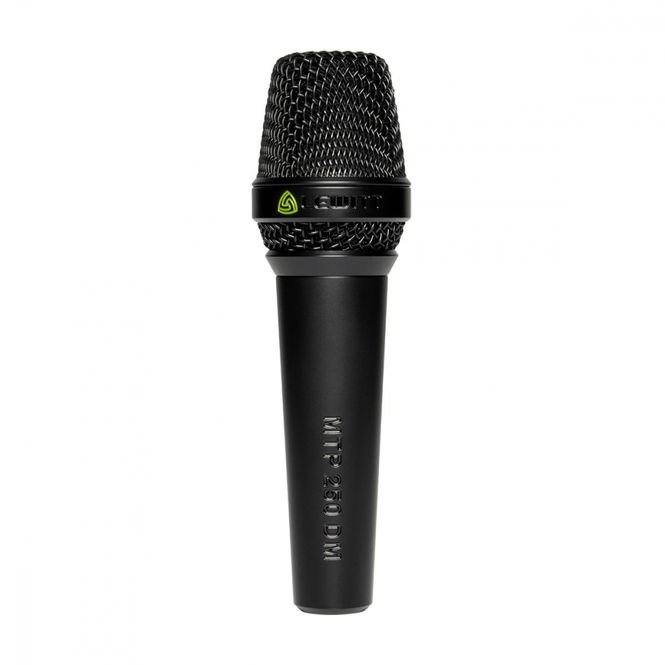
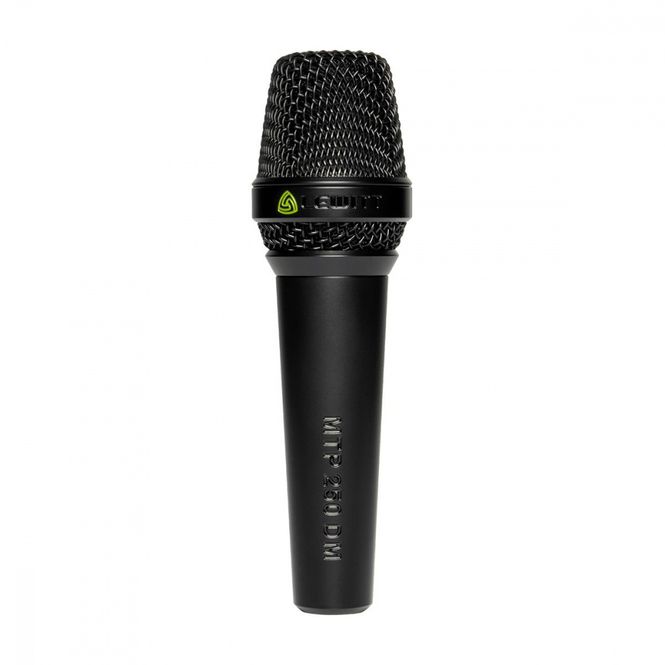
Lewitt MTP 250 DM Handheld dynamic microphone with cardioid pattern. Dynamic vocal microphone Tailored vocal sound Durable materials for longevity Cardioid polar pattern Switch version available The MTP 250 DM is your first-choice handheld microphone for onstage applications. The frequency response of the high-performance capsule is tailored specifically for your vocals. Your voice will cut through the mix in any live environment. The stage is yours. Acoustical operating principle - Dynamic, moving coil Polar pattern - Cardioid Frequency range - 60 ... 18,000 Hz Sensitivity - 2 mV/Pa, -54 dBV/Pa Internal impedance - 280 Ω Rated load impedance - 1,000 Ω Connector - Gold plated 3-pin XLR Microphone dimensions - 49 dia. x 170 mm, 1.9 dia. x 6.7 in Microphone net weight - 300 g
Lewitt MTP 250 DMs Dynamisk ...

1.149,-

Lewitt MTP 250 DMs Handheld dynamic microphone with cardioid pattern. Switch version. Dynamic vocal microphone with switch. Tailored vocal sound Durable materials for longevity Cardioid polar pattern The MTP 250 DM is your first-choice handheld microphone for onstage applications. The frequency response of the high-performance capsule is tailored specifically for your vocals. Your voice will cut through the mix in any live environment. The stage is yours. Acoustical operating principle - Dynamic, moving coil Polar pattern - Cardioid Frequency range - 60 ... 18,000 Hz Sensitivity - 2 mV/Pa, -54 dBV/Pa Internal impedance - 280 Ω Rated load impedance - 1,000 Ω Connector - Gold plated 3-pin XLR Microphone dimensions - 49 dia. x 170 mm, 1.9 dia. x 6.7 in Microphone net weight - 300 g
Viser 1341 til 1350 (av 3692 produkter)
  • vipps-orange.png
  • klarna-light.png
  • mastercard-full.png
  • visa.png